
B2B Client Centricity
The client promise is not delivered by the front officealone.
We help complex B2B service organisations make their support, expert and control functions clearer, more predictable and more solution-oriented.
Luxembourg · France · International | Programmes in English and French
Clear+Predictable+Responsive+Solution-oriented+Educational+Accountable+Proactive+Clear+Predictable+Responsive+Solution-oriented+Educational+Accountable+Proactive+
Our conviction
When the front office makes a promise and the rest of the organisation is not aligned, the client pays for the friction.
A late response, a period of silence, a hand-off without an owner or a refusal without options directly erodes trust. B2B Client Centricity is therefore a collective performance issue, not merely a commercial skill.
Explore the warning signsThree ways in
The same challenge. Three sponsor perspectives.
Make Client Centricity a strategic priority
Align the value chain, turn ambition into decisions and establish shared standards beyond the front office.
Help support functions deliver the commercial promise
Reduce friction, accelerate arbitration and give clients greater visibility on how their requests are being handled.
Move experts towards a genuine partner stance
Develop Legal, Compliance, Operations or client-service teams without weakening their professional mandate.
When to act
Everyone did their job.
Yet no one is satisfied.
The starting point depends on your context. These signals generally show that the client promise needs to be addressed beyond the sales team.
- 01Complaints or an insufficient NPS↘
The same pain points recur even though every team believes it has respected its remit.
- 02Loss of clients or trust↘
The client does not know who truly owns the request or when a response will arrive.
- 03Tension across Sales, Operations and Compliance↘
Arbitrations happen late, requests circulate and workarounds multiply.
- 04Escalations and uneven service quality↘
The response still depends too much on the individual, channel or seniority level involved.
- 05An executive priority↘
The organisation wants to translate client ambition into observable standards and operating decisions.
Your situationThe right programme starts with the right diagnosis.
Talk to Romain WeAre the Podcast · Special edition
Is Luxembourg truly client-centric?
A 40-minute conversation about the gap between client intent and operational reality, the role of non-commercial functions and the different levels of organisational maturity.
With Clément Trinquart, CEO of ClubtrustEnglish versionWatch on YouTubeWho it is for
Non-front-office Client Centricity is often where the difference is made.
The same principles adapt to different mandates, professions and levels of maturity. We start with real situations, never a one-size-fits-all model.
Control functions
Legal, Compliance, Risk and governance functions: protect the mandate while framing useful options for the business.
Client services & Operations
Improve ownership, responsiveness, predictability and the quality of hand-offs throughout the service chain.
B2B experts
Lawyers, accountants, auditors, fiduciaries and consultants: move expertise towards a genuine partner stance.
Our method
From awareness
to standards that work in real life.
Every programme is co-designed with the sponsor. The ambition, target populations, real cases, indicators and required level of embedding are agreed at kick-off.
Align the sponsor on the client promise, expected outcomes and target behaviours.
Understand the expectations of the client, their stakeholders and everyone contributing to the experience.
Separate what relates to permission or ability, know-how and willingness to act.
Turn lived tensions into options, decisions and immediately applicable practices.
Clarify responsibilities, deadlines, decision criteria, escalation levels, permissions and protections.
Run 30-day experiments, measure the effects and integrate the learning into the system.
Modular by design
One ambition. Several ways to start.
There is no universal format. We assemble the right modules according to the population, maturity and level of transformation required.
01
Create awareness
Executive or Partners Workshop
Short format · tailored
A workshop to share the diagnosis, set a common ambition and identify the organisation’s structural decisions.
For executive committees, partners, business leaders or leadership communities.02
Change day-to-day practice
Client Centricity Team Lab
Workshop or training · tailored
Applied work on real situations to build a method, clarify ownership and produce observable standards.
For one team, one profession or several interdependent functions.03
Transform the system
Enterprise Transformation Journey
6 to 12 months
A programme combining executive framing, diagnosis, cross-functional pilots, training, coaching, experiments and management anchoring.
To turn Client Centricity into an organisation-wide operating principle.Client Centricity Coaching for C-Level
Coaching for Legal, Compliance, Operations and other C-level leaders seeking to shift their own stance and that of their function.
Individual & team AssessFirst
Individual and collective reports used as an additional lens on preferences and motivations, never as a Client Centricity score.
What we seek to change
Observable behaviours. Measurable effects.
Indicators are defined with the sponsor at kick-off, based on the programme’s ambition and maturity. We do not promise one universal number: we build the evidence that matters in your context.
Behavioural standards
Explicit expectations for ownership, response, escalation, recommendation and follow-through.
Predictability & responsiveness
Less silence and more visibility on deadlines, decisions and next steps.
Experts as partners
A shift from protector to partner without weakening the expert or control mandate.
Smoother collaboration
Less friction across Sales, Operations and control functions, with clearer ownership.
Client experience
Possible indicators include NPS, complaints, escalations, retention and service quality.
Anonymised case study
Making client experience more predictable in a complex organisation.
A fast-growing Luxembourg fiduciary and AIFM wanted to move from a collection of expert services to a genuinely unified experience — without compromising the rigour of its regulated professions.
Everyone does their job in their own corner. Yet the collective experience disappoints.
year of transformation
A progressive programme delivered over twelve months.
employees involved
Partners, directors, managers, experts and support functions.
working sessions
3 Partner workshops, 2 pilots, 12 team sessions and 1 retrospective.
co-designed standards
Responsiveness, solution orientation, quality, proactivity and accountability.
The context
The commercial one-stop shop had created a new obligation to collaborate.
Clients were buying several services from an organisation that had become larger and harder to navigate. At the same time, operational pressure was rising and digital competitors were entering the market.
Uneven standards
Proactivity and ownership still depended too much on the profession or the individual.
Ownerless hand-offs
Cross-team transfers lacked follow-through, visibility and accountability.
An unreadable organisation
Clients saw several departments where they expected one unified experience.
Experts not equipped
Specialists promoted for technical excellence had never been trained or assessed on the client dimension.
Late escalations
Partners sometimes had to step in to resolve delays, mistakes or internal tension.
Silent attrition
Some pain points became visible only after trust — or the client — had already been lost.
The approach
Let the organisation shape the standards, then test them against real work.
The programme was co-sponsored by the Director of Client Experience and a Partner. Romain led the facilitation, with the Director co-leading the Partner workshops and present throughout the journey.
- 01
Align the Partners
Share tensions, clarify the ambition and establish the decision framework.
- 02
Listen without exposing
Director interviews, an anonymous survey, then small groups with anonymised outputs.
- 03
Test with pilots
Two pilot workshops to adjust the learning design, psychological safety and working cases.
- 04
Deploy in mixed cohorts
Six Awareness and six Action sessions of four hours, bringing professions together instead of reinforcing silos.
- 05
Converge and hand over
A Partner workshop followed by a retrospective to consolidate the standards and return ownership to the Director of Client Experience.
Real work as the raw material
Three lived situations to move from intention to protocol.
Protect without abandoning the client
How to build one clear position across functions, explain the mandate and frame a workable option in a sensitive situation.
Repair the error and secure the chain
How to regain ownership of an incomplete report, coordinate teams and prevent a short deadline from becoming a crisis of trust.
Clarify who does what — and when
How to address the client’s immediate need while clarifying the roles of the AIFM, central administration and other stakeholders.
What was built
A shared language translated into observable behaviours.
Employee and leadership expectations were compared and then converged. The work created a coherent foundation for communication, management and, over time, HR processes.
Responsiveness
Acknowledge the request, provide a realistic timeline and make the next step visible.
Solution orientation
Explain constraints while framing options and offering a recommendation.
Quality
Secure deliverables, controls and the consistency of the information provided.
Proactivity
Anticipate useful information, risks and expectations before the client has to chase.
Accountability
Remain responsible for the request, including when specialist input must be handed over.
Evidence and boundaries
What this case study can substantiate — and what it does not claim to prove.
A multi-source diagnosis, hundreds of working contributions, anonymised real client cases and five co-designed standards.
The whole organisation joined the journey; functions and seniority levels worked together on the same situations.
The Director of Client Experience, Partners and HR expressed their satisfaction with the programme.
Post-programme embedding decisions and operational results remain the client’s property and are not published.
Our embedding recommendations
Turn the standards into a management system.
- 01
Integrate the five standards into roles, objectives and evaluation criteria.
- 02
Give teams explicit permissions together with the protections required to act.
- 03
Establish a quarterly retrospective loop around pain points and client cases.
- 04
Train new joiners on roles, service commitments and hand-off rules.
- 05
Recognise exemplary behaviours before considering any sanction mechanism.
- 06
Track a focused set of indicators: ownership times, escalations, complaints, quality and retention.
Anonymised study. Identifying information, client data and unauthorised results have been removed.
Trusted by clients
What clients remember about working with Romain and Talantlers.
Recommendations centred on trust, co-design, practical relevance and tangible impact.
You can fully trust Romain as a partner for your organisation. We have embarked together into a client centric journey I am sure we will succeed.
Attentive, responsive, flexible, professional, detail-minded and full of sound advice — these are some of the qualities I consistently find in Romain and Talantlers.
What I value most is their ability to understand our sector and our needs, and to adapt quickly to our environment.
We worked hand in hand to design a personal development programme. The content was exactly what we needed and directly connected to our day-to-day challenges.
Romain naturally inspires trust: he is direct and authentic, brings real business experience, and uses approaches that are firmly action- and people-oriented.
He knows the operational side of the business, enabling him to provide advice and training that are perfectly adapted to realities on the ground.
Excerpts from LinkedIn recommendations. French reviews have been translated and shortened without changing their meaning.
Our principles
No predictability.No trust.
01Make it clearthe mandate, decision criteria, timelines and next step.
02Offera framework, options and a recommendation rather than a simple yes or no.
03Remain accountablefor the client request even when specialist input needs to be handed over.
04Preventrecurring pain points rather than treating each incident as an isolated case.
The WeAre collective
An offer backed by experts who understand operational reality.
WeAre brings together entrepreneurs, leaders, coaches and trainers who combine business, human and operational perspectives. Depending on the programme’s ambition, Romain assembles the right team around your context.
Discover the WeAre collective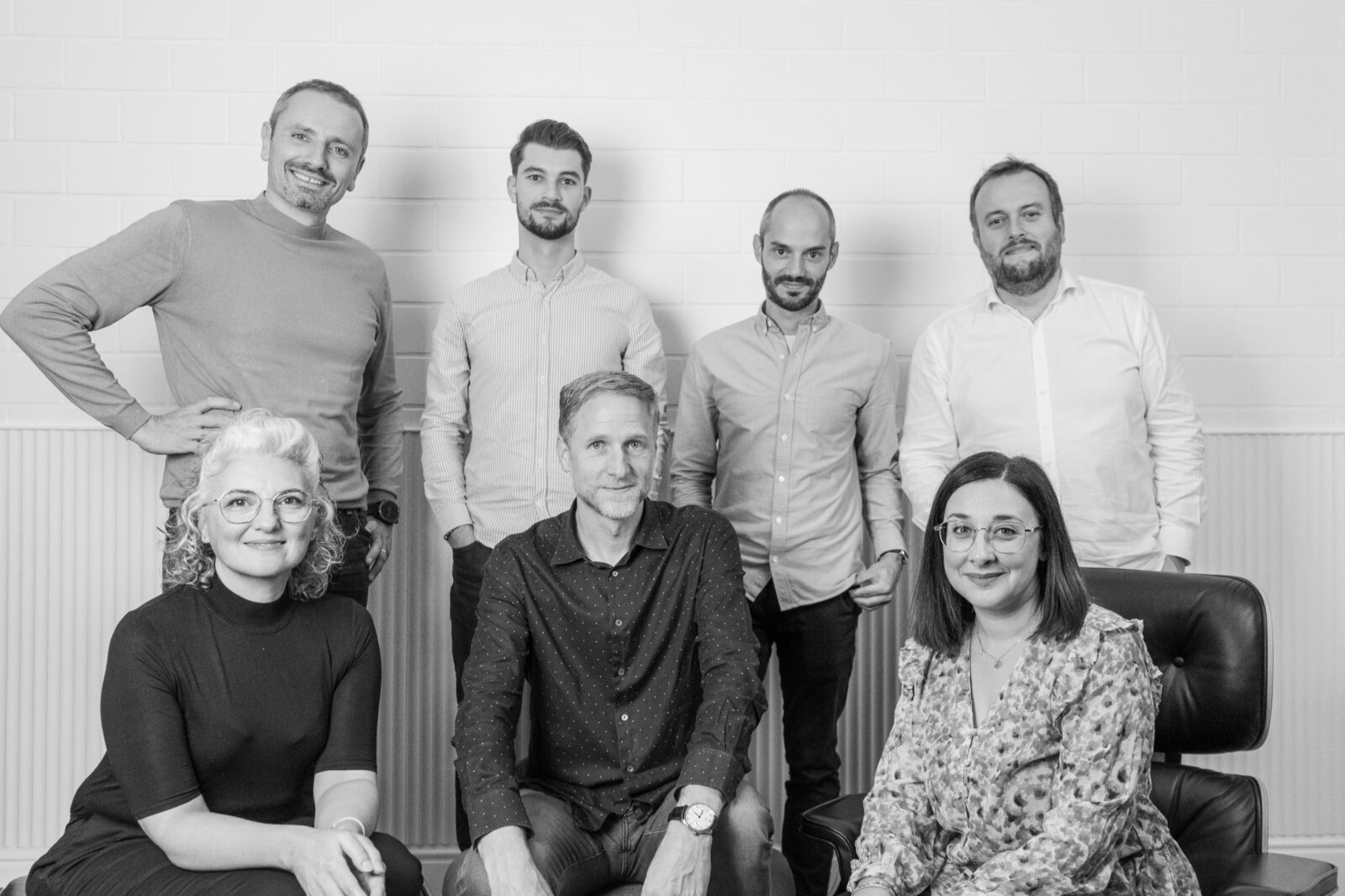 WeAreDiscover the WeAre collective
Frequently asked questions
What you need to know before getting started.
Is Client Centricity only relevant to sales teams?
No. Differentiation is often created by support functions, Operations, experts and control functions that make the commercial promise possible in practice.
Do we need a mature Client Centricity strategy already?
No. The engagement can start with awareness, targeted training, executive coaching or a six-to-twelve-month transformation programme. The format depends on your starting point.
Does a client-centric stance weaken Legal or Compliance?
No. The mandate does not change. We work on how it is exercised: making the framework clear, explaining the issues and formulating options or recommendations within the constraints.
How do you measure results?
Indicators are agreed with the sponsor at kick-off. They may cover behaviours, ownership, response times, escalations, complaints, NPS, retention or internal collaboration.
What role does AssessFirst play?
AssessFirst is offered to programme participants as an individual and collective lens. It is not a Client Centricity score.
Can programmes be delivered in French?
Yes. Programmes can be delivered in English or French, in person, remotely or in a hybrid format.
Your next step
Let’s discuss your challenges, diagnose the starting point and design the useful response.
A first conversation to understand your context and determine whether, and how, we can be useful.
Contact